Steering feels unstable?
If the steering feels loose or wanders, a wheel feels like it's wobbling, or a tyre's losing pressure after a hard hit, find somewhere safe to stop and don't drive further. RACV says to avoid driving on in those cases. If you've got roadside assistance, call them. If anyone is hurt or in danger, call 000.
What's that noise? A rough guide to suspension sounds
| Usually points to | What to do | |
|---|---|---|
| A hum or growl that rises with speed | A wheel bearing (the bearing each wheel spins on) | Get it checked soon. It gets louder as it wears |
| Clicking on tight turns, like in a car park | A CV joint (the flexible joint in a front-drive axle) | Look for a split rubber boot and get it quoted |
| A clunk over bumps | Bushes, ball joints, links or a loose mount | Have it inspected on a hoist |
| Bouncing or floating after a dip | Worn shock absorbers | Have them checked, in pairs |
| Pulling to one side, or a crooked steering wheel | Wheel alignment, or a bent part behind it | Get the alignment checked |
What does a suspension job involve?
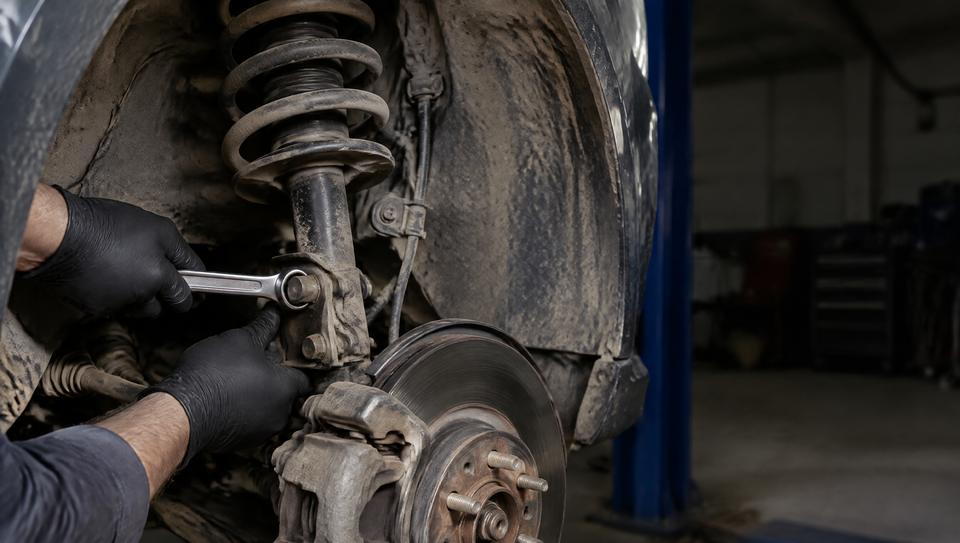
The mechanic puts the car on a hoist and checks each corner by hand and by eye: play in the bearings and joints, oil on the shocks, cracked rubber bushes, and split boots on the CV joints. A road test follows, because some noises only turn up at speed or under load.
Then it depends on what's found. A link or bush can be a short job. Struts, control arms and bearings pressed into a hub take longer. Most suspension work ends with a wheel alignment, because taking it apart moves the angles.
Why does worn suspension wear out tyres?
RACV says worn suspension puts stress on other expensive parts, tyres first. Leaking shock absorbers or tired bushes stop soaking up the road, so the tyre takes the hits. NRMA says tyres worn unevenly but not worn out are usually a sign of a steering or suspension problem.
RAA's tell is wear on the inner or outer edge. If you can see it, have an alignment check, because it can also reveal damage to steering or suspension parts. That's cheaper to hear about before a new set of tyres goes on.
When does suspension need looking at?
There's no schedule for most of this. It wears with kilometres, load and road surface. RACV says a severe pothole strike can damage shock absorbers, struts, springs, control arms and wheel bearings, and it can knock the wheels out of alignment with no visible damage at all. RAC WA adds kerbs and speed humps taken too fast.
After a big hit, RACV suggests watching how the car drives over the next few days. Pulling, a crooked wheel, odd noises or new tyre wear are your signal.
For alignment alone, NRMA says every 12 months or 20,000 km is a good idea for long tyre life. RACV says don't skip one after suspension work.
What kind of mechanic suits this?
Most general mechanics do bushes, shocks and bearings. NSW even has a tradesperson class just for steering, suspension and wheel alignment, though it leaves out hybrids and battery electric cars, so tell the mechanic if yours is one. A car that tows, carries a load or has a raised 4WD setup is worth sending to someone who sees those every week: the parts and the alignment settings differ.
What a good written suspension estimate shows
- Which corner, which part, and what was found.
- Whether parts are being done in pairs across the axle, and why.
- Any part that's worn but can wait, marked as such.
- A wheel alignment, included or listed separately.
- Whether reconditioned or exchange parts are being used.
What you can do, and what to leave
You can
- Look across the tyre tread for wear on one edge.
- Check for a crooked steering wheel on a straight, flat road.
- Note the noise: which side, what speed, turning or straight.
- Parked on flat ground, push down hard on a corner. It should settle quickly, not keep bouncing.
Leave to the mechanic
- Anything under the car. Never get under a car held up only by a jack.
- Springs and struts, which hold a lot of stored force.
- Wheel bearings, CV joints and steering parts.
- The wheel alignment afterwards.
Our take
Don't guess at the part from the noise. We'd tell the mechanic exactly when it happens, ask them to show you the worn part on the hoist, and get the estimate split into what's needed now and what can wait. If a hit from a pothole started it, say so. And if new tyres are on the way, get the suspension and alignment checked first, so they don't wear the same way.