Mobile mechanic or workshop?
| Usually suits a mobile mechanic | Usually needs a workshop | |
|---|---|---|
| Starting and charging | Battery replacement, and many alternator and starter jobs where the parts are easy to reach | Starter motors buried under the manifold or inlet |
| Servicing | Oil, filters and routine logbook checks | Major services with a lot of fluid changes or a timing belt on a tight engine bay |
| Brakes and suspension | Pads and some discs, on firm level ground | Wheel alignment, which needs an alignment machine |
| Drivetrain | Finding out what's wrong | Clutches and gearboxes, which need a hoist and a lot of room |
| Exhaust and welding | Checking and quoting | Pipes and mufflers, where the car has to go up |
What can a mobile mechanic do at my place?
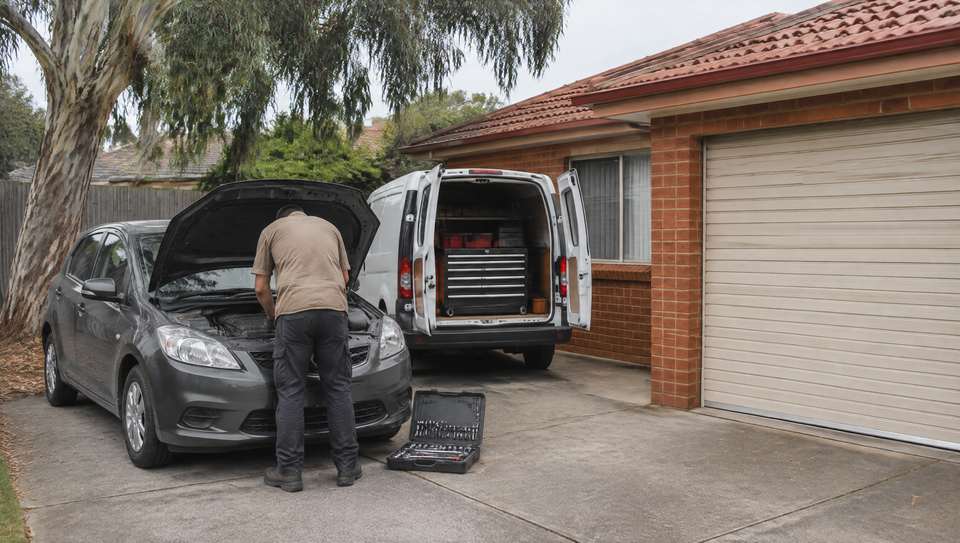
More than most people expect. A well set-up van carries a scan tool, oils, filters, common batteries and hand tools, so a lot of everyday work can happen in a driveway or a car park at work. The limit is the hoist: if the mechanic needs to stand under the car, it's a workshop job.
That makes a mobile mechanic a strong first call when the car won't move. They can find out why it won't start, fix it if it's simple, and tell you straight if it needs a tow.
Parts are the other limit. Some jobs on some cars need a part ordered, so a second visit is normal. Giving the make, model and year up front cuts the chance of that.
Is a mobile mechanic the same as roadside assistance?
No. RACQ describes roadside assistance as help that comes to you when you break down: a jump start, some fuel, a lockout, swapping to the spare, or a tow to a nearby mechanic if the car can't be fixed on the spot. What's included depends on your cover.
A mobile mechanic does the service or repair itself, at a time you've arranged. If you're stuck on the side of a busy road, this isn't the service you need. Call roadside assistance, and call 000 if anyone's hurt or in danger. Once the car's somewhere safe, a mobile mechanic can pick it up from there.
Does a mobile mechanic need a licence?
It depends on the state. NSW says you need a licence to run a motor vehicle repair business, and it names mobile repair businesses and part-time work. WA says every business in the motor repair and servicing industry needs a repair business licence, and the ACT licenses repairers with a public register. In those three, it's worth looking the business up.
Victoria, Queensland, South Australia, Tasmania and the NT have no general mechanic licence that we've found. There, ask about the mechanic's trade qualifications and experience with your make.
Working from a van doesn't change your rights. Repair services under the Australian Consumer Law must be supplied with due care and skill, wherever the car's parked.
Questions to ask a mobile mechanic
- Can this job be done where the car is, on this surface?
- Will you bring the parts, or is this a two-visit job?
- If you find it's a workshop job, what happens next?
- Will you stamp the logbook or update the digital record?
- Is any travel or call-out charge on the estimate?
What a good written estimate from a mobile mechanic shows
- The job, the parts and the labour, listed separately.
- Any travel or call-out charge, as its own line.
- Where the work will happen and what the mechanic needs from you.
- The warranty on parts and on the work, on the invoice.
- A number to call if something isn't right afterwards.
How to get ready, and what to leave
You can
- Park on flat, firm ground, away from traffic, with room to open the doors and bonnet.
- Have the keys and the service book handy.
- Check the rules first if the car's in an apartment or work car park.
- Take a photo of any warning light before the battery goes flat.
Leave to the mechanic
- Deciding whether the job's safe to do on site.
- Lifting the car. Never get under a car held up only by a jack.
- Disposing of old oil, batteries and parts.
- Testing the car once the job's done.
What we'd do
If the car won't start at home or at work, we'd go mobile first, because the mechanic sees the fault where it happened and you may not need a tow. For a known job like a battery or a routine service, it's mostly about whether you'd rather not lose half a day. For anything the car has to go up on a hoist for, we'd skip the visit and go straight to a workshop. Tell us the job and we'll point it the right way.