Flashing or red light on the dash?
Don't wait for a scan. A flashing engine light, a red warning or a car that's lost power means pull over somewhere safe and switch off. Stay well clear of passing traffic, and ring roadside assistance if you have it. If anyone is hurt or in danger, call 000.
What does a diagnostic scan read?
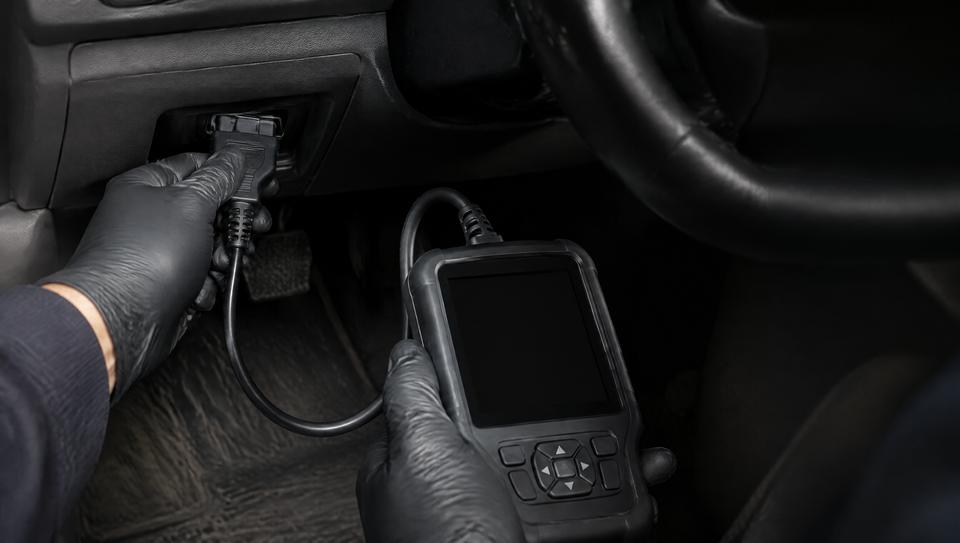
Your car watches itself constantly. When a reading goes outside its limits, the computer stores a code and may put a light on the dash. A scan tool plugs into a 16-pin port within reach of the driver, usually under the dash, and reads those codes along with live data from the sensors.
In Australia, the rule behind the port is ADR 79, the local equivalent of the American OBD-II standard. It applied to petrol cars from 1 January 2006 and diesels from 1 January 2007, so nearly any car from the past couple of decades can be read this way. Many earlier cars have ports too, but they vary.
Each code has five characters. The first letter shows the area: P for powertrain, B for body, C for chassis and U for network. The rest narrow it down to the system and the problem found.
Why doesn't a code tell you what's wrong?
A code records what the computer noticed, not why it happened. A misfire code on one cylinder could mean a spark plug, a coil, an injector or low compression. An oxygen sensor code could be the sensor, its wiring, or an air leak that's upsetting the reading.
Replacing whatever the code names is how people end up with new parts and the same problem. Clearing the code doesn't fix anything either. The light goes off, the fault stays, and it usually comes back.
A basic code reader or a workshop scan tool?
| Basic code reader | Workshop scan tool | |
|---|---|---|
| What it reads | Mostly engine and emissions codes | Most of the car's systems, often including ABS, airbags and the gearbox |
| Live sensor data | Limited | Yes, and it can often record it on a road test |
| Running tests | Rarely | Often, such as working a component to see if it responds |
| What it leaves you with | A code and a guess | A starting point, with the data to test it |
Why isn't every scanner the same?
The standard only requires emissions-related data at the port. Many manufacturers use it for diagnosing and programming all the other systems as well, in their own way. That's why a mechanic who works on your make, with a tool that talks to it, can see far more than a generic reader. It matters most on European cars and newer cars packed with electronics.
How a proper diagnostic goes
The story
When it started, how often, hot or cold, what the car does. What you've noticed can save more time than the scan.
A full scan
Every system, not just the engine, because one fault can leave codes in several places. The mechanic records them before clearing anything.
Live data and a road test
The mechanic watches the sensors while the fault happens, if it can be made to happen.
Tests on the suspect part
Wiring, pressure and fuel tests prove the cause before any part gets ordered.
Repair and check
After the repair, the mechanic clears the codes and road-tests the car to confirm they don't return.
What a good written estimate covers
- How much diagnostic time is included, and what happens if it runs over.
- The codes that were found, listed for you.
- What was tested, and what those tests showed.
- The cause, or the next step if it isn't found yet.
- The repair, with parts by name, shown apart from the diagnostic.
What you can do, and what's the mechanic's job
You can
- Photograph the dash with the lights showing.
- Note what the car was doing when the light came on: speed, weather, hot or cold.
- If you own a code reader, write the code down, but don't clear it before a mechanic sees it.
- Mention any recent work, a flat battery, or a new accessory wired into the car.
Leave to the mechanic
- Interpreting the code and testing the cause.
- Airbag and ABS faults. Those are safety systems, so leave them to the mechanic.
- Anything that needs programming or coding.
What we'd do
We'd write down what the car's doing, photograph the light, and leave the codes alone until a mechanic has seen them. Then we'd ask one question: what are you going to test before replacing anything? A good answer tells you you've found the right person. And if someone names a part straight off the scan, ask how they know.