Gauge climbing, steam or thick white smoke? Stop first
Pull over somewhere safe and switch the engine off. Never open a radiator or coolant cap on a hot engine: the system is under pressure and can burn you. Don't drive on to get home, because every extra kilometre hot can turn a gasket job into a new engine. Get everyone away from the traffic, and call roadside assistance if you have it. If anyone is hurt or in danger, call 000.
What does a head gasket do?
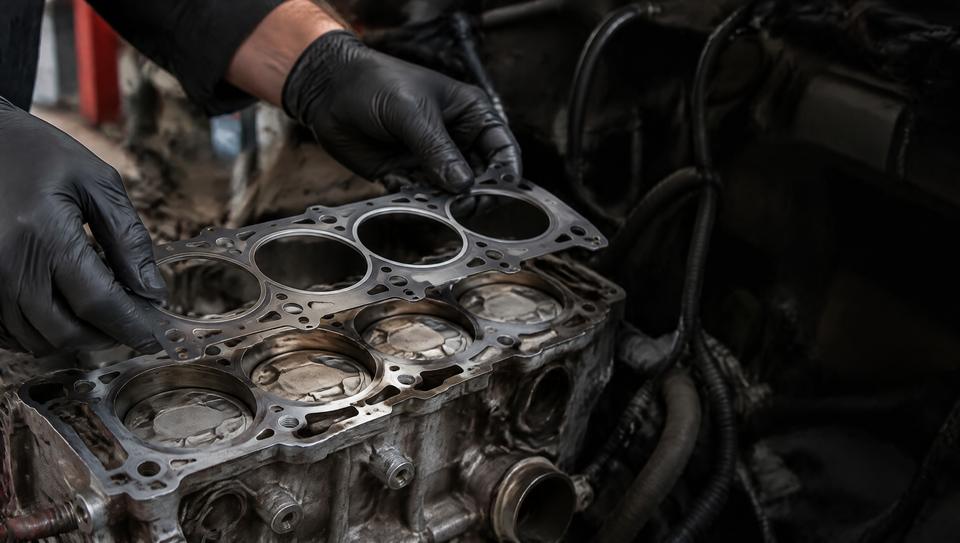
It's the seal between the engine block and the cylinder head, the two big castings that make up the engine. It keeps the burning gases in the cylinders and keeps coolant and oil out of them, all while everything around it heats up and cools down.
When it fails, those three things start crossing over. That's what a blown head gasket means, and it's why the signs can look so different from one car to the next.
Signs it could be the head gasket
- Overheating, particularly if it's new or keeps coming back.
- White exhaust smoke that doesn't clear once the engine warms up, which can mean coolant is getting into the cylinders.
- Coolant dropping with no leak you can find.
- Foam in the coolant tank, which you can see through the plastic on a cold engine.
- Rough running or lost power from a cylinder losing compression.
- A creamy, mayonnaise-like layer on the dipstick or oil cap. It's a clue, not proof: short trips can cause it too.
How a mechanic proves it
Pressure-test the cooling system
This rules out the simpler causes first, such as a hose, radiator or water pump leak. See radiator and cooling system repairs.
Test the coolant for exhaust gases
A chemical tester shows whether combustion gases are getting into the coolant. If they are, the fault is at the gasket or the head.
Run a compression test
It shows whether any cylinder is down on pressure, but it can't show where the pressure is going.
Run a leak-down test
Compressed air goes into each cylinder, and the mechanic sees where it escapes. A failing head gasket may show up as bubbles in the coolant. Used together, the two tests give a clearer answer than either one alone.
What's involved in the repair?
The gasket is usually a small part. The time goes into everything around it. The mechanic drains the fluids, then removes the manifolds, the timing gear and the head itself, before cleaning every surface and refitting it all.
A head that has overheated can warp, so it usually goes to a machine shop to be checked for flatness and for cracks, and to be resurfaced if needed. Many engines also need new head bolts rather than reusing the old ones. After that come new fluids, the timing set up again and a road test.
What makes the job bigger or smaller?
The engine layout. A V-shaped engine has two heads, and a tight engine bay means more comes out to reach them.
How hot it got. A head that's warped or cracked needs machining or replacing. If the bottom end took damage too, the conversation changes.
What else is due. With the timing belt off anyway, it's the moment to replace it if it's near its date.
Why it failed. If a blocked radiator or a failed water pump overheated the engine, that has to be fixed too, or a new gasket could go the same way.
What a good written estimate covers
- The test results that point to the gasket.
- Machine shop work on the head, and what happens if it's cracked.
- Head bolts, gasket set, coolant, oil and filter.
- The timing belt and water pump, if they're being done at the same time.
- The cause of the overheating, and how it's being fixed.
- The warranty on the repair, in writing.
What you can do, and what's the mechanic's job
You can
- Check the coolant level in the see-through tank, on a cold engine only.
- Watch the temperature gauge and note when it climbs.
- Take a photo of any smoke, foam or residue.
- Hold off on a bottle of head gasket sealer until a mechanic has seen the car.
Leave to the mechanic
- Every test on the cooling system and cylinders.
- Opening the cooling system, and only once it's cold.
- Everything involved in taking the head off and putting it back.
Our take
Don't let the words blown head gasket make the decision for you. We'd ask for the test results, then the full written estimate, then weigh that against the car's age, condition and what else it needs. On a newer or well-kept car, the repair often makes sense. On a tired one, it's fair to ask whether the money is better spent elsewhere. A mechanic who does these regularly will tell you straight.