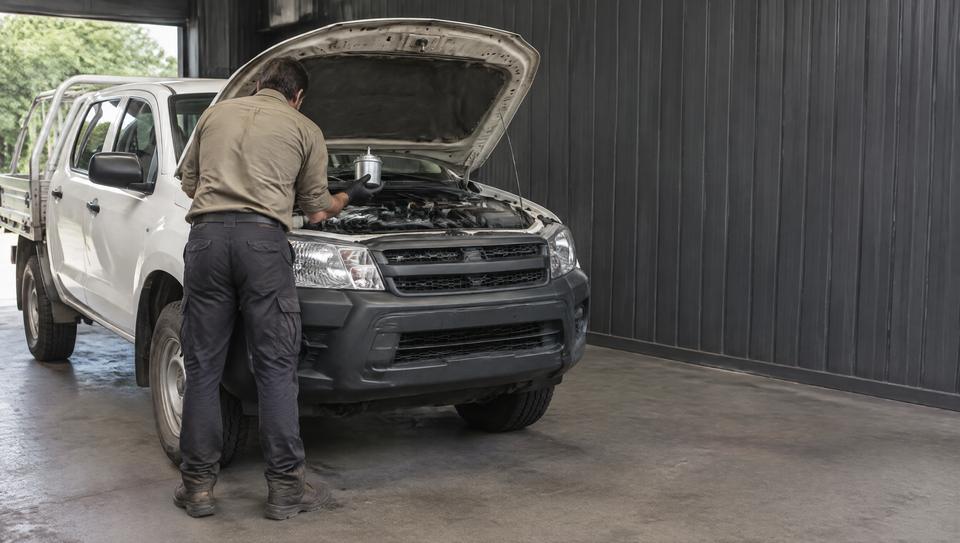
Wrong fuel in the tank?
Don't start the engine. NRMA says even the smallest amount of petrol can damage a newer common-rail diesel, so arrange a tow to a workshop. If you've already driven off, stop somewhere safe and switch off as soon as you can. AdBlue in the fuel tank is just as serious: RAC WA says don't drive the vehicle or even turn on the ignition.
What's different about servicing a diesel?
A modern diesel injects fuel at very high pressure through injectors with tiny holes. Clean fuel matters more than on a petrol engine, so the fuel filter and water trap are a bigger deal at service time.
Intervals can be shorter too. Toyota keeps six-month/10,000 km servicing on the HiLux, Prado and LandCruiser, and it told CarExpert that's because Australian conditions can be harsh. RACV says towing, dusty roads and heavy loads can call for around every six months on any car. Follow your own book, and be honest with yourself about how the car gets used.
Then there's the emissions gear. The particulate filter and the AdBlue system both need a car that gets driven properly, and the exhaust and DPF page covers the filter side.
What is AdBlue, and what happens if it runs out?
AdBlue is a colourless mix of urea and de-ionised water, kept in its own tank. RACQ says it only goes in vehicles with an SCR system, where a small measured amount is injected into the exhaust to turn nitrogen oxides into nitrogen and water.
RAC WA says tanks typically hold about 15 to 20 litres, and to plan on roughly 10 to 15 litres per 10,000 km. Top it up before a long trip or a tow. A light comes on when it's low.
Don't ignore that light. If the system runs dry, RACQ says the car won't start, and RAC WA says some go into limp mode instead. Water or any other liquid won't keep it working.
What are diesel fuel bugs?
They're bacteria and fungi that live where diesel meets water. RACQ says some can double every 20 minutes in the right conditions, making a slimy sludge that blocks filters and fuel systems. Their acids corrode metal and rubber parts as well.
Water in the tank is what lets them in, and vehicles that sit around are most at risk. So a caravan tow car, a farm ute or a weekend 4WD can get caught out. Fuel filters that keep blocking are the warning sign.
The fix, RACQ says, is draining and steam-cleaning the tank, changing the filters and adding a biocide to fresh fuel. Biocide alone can leave dead material that keeps on blocking filters.
Does diesel injector cleaning work?
It depends on what's meant by cleaning. A bottle of additive in the tank is one thing. Taking the injectors out and testing them on a bench is another. If an injector is worn or leaking, cleaning won't bring it back.
So test first. A diesel mechanic can scan the injector readings, check for leaks and look at fuel pressure, then tell you if it's dirty, worn or something else. Rough idling, white or black smoke, knocking and poor fuel use can all come from injectors, but they can come from other parts too. There's more on our fuel injectors page.
Questions to ask a diesel mechanic
- Do you work on this engine regularly, and do you have the scan tool for it?
- Do you test injectors here, or send them out?
- How will you confirm the fault before replacing parts?
- Which oil are you using, and does it meet the spec for a DPF-equipped engine?
- Will you check the water trap and top up the AdBlue at the service?
What a good written diesel estimate shows
- The service interval, and the oil and filters going in, by name.
- The fuel filter, and when it was last changed.
- AdBlue, if it's being topped up.
- Injector test results, if injectors are being replaced or cleaned.
- Any DPF work, and what caused it.
What you can do, and what to leave
You can
- Watch the AdBlue gauge or light, and top it up as the manual says. Wear gloves and wipe up spills: RAC WA says it's corrosive.
- Check bowser labels before filling.
- Give a short-trip diesel a proper highway run.
- Use a car that sits around regularly, and keep water out of any stored fuel.
Leave to the mechanic
- The high-pressure fuel system. Never open it yourself: the pressure can injure you.
- Injectors, the fuel pump and the turbo.
- Draining a contaminated tank. NRMA says not to siphon it.
- Forced regeneration and fault codes.
If it were our car
We'd use a mechanic who sees that engine often, because diesel faults overlap and parts aren't small purchases. For a routine service, we'd make sure the oil spec is right and the fuel filter is on schedule. For a running problem, we'd ask for a test before anyone suggests injectors. If you tow or do bush kilometres, say so, because it changes the advice. Tell us the car, and the mechanic can talk you through it.