Strong smell of fuel in or around the car?
Pull over somewhere safe, switch off and get everyone out of the car. Keep away from anything that could light it, and don't restart the engine. A strong fuel smell can mean a leak at an injector seal or fuel line. Get the car towed, and if you can see fuel pooling or there's any fire, stay clear and call 000.
What does a fuel injector do?
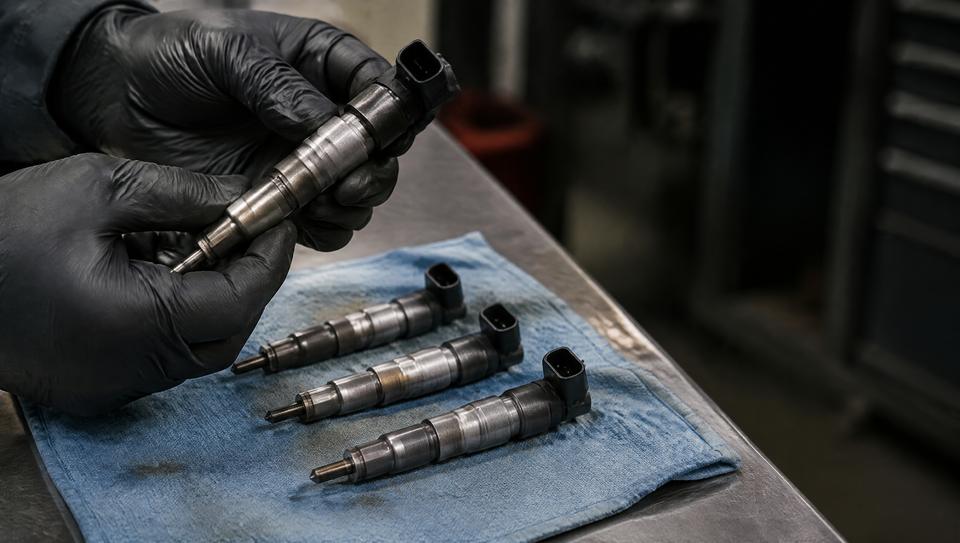
An injector is a very fast, very precise spray nozzle. The engine computer opens it for a split second, and fuel goes in as a fine mist that burns cleanly. Deposits or wear spoil that spray, and the engine notices straight away.
Where the spray goes depends on the engine, and that changes what can go wrong.
Three kinds of injection, three kinds of problem
| Petrol port injection | Petrol direct injection | Common-rail diesel | |
|---|---|---|---|
| Where the fuel goes | Into the intake port, just before the valve | Straight into the cylinder | Straight into the cylinder, from a shared high-pressure rail |
| What builds up | Deposits at the injector tip | Tip deposits, plus carbon on the intake valves | Deposits, and wear from dirty fuel or water |
| What usually helps | A clean, if testing shows poor flow | An injector clean won't touch valve carbon: that's its own job | Testing each injector, then repairing or replacing the worn ones |
Why do direct injection engines get carbon build-up?
On a port-injected engine, fuel washes over the back of the intake valve and keeps it clean. Direct injection skips that step, which can mean increased carbon deposits on the valves. Some of these engines add a second set of injectors in the manifold, and those help keep the intake clean.
This catches people out. The car runs rough, someone cleans the injectors, and nothing changes because the problem was never in the injectors.
Signs an injector needs a look
- A rough idle or a misfire, often with the engine light on.
- Hesitation or a flat spot when you press the accelerator.
- Using noticeably more fuel than it used to.
- Hard starting, especially when the engine is hot.
- Black or white smoke from a diesel, or a knock that wasn't there before.
How does a mechanic test injectors?
A scan comes first, to show misfire counts and whether the computer is compensating for a cylinder. On a petrol engine, the mechanic can then compare how each injector flows, either on the car or on a bench.
Diesels get a closer look, because common-rail systems typically run at over 2,000 bar and tiny amounts of wear change how the engine runs. A leak-off test and the computer's correction figures show which injector is drifting. That's work for a mechanic who does diesels regularly: see diesel servicing and repairs too.
Clean, repair or replace?
A bottle of cleaner in the tank is upkeep, and it won't rescue a failing injector. An on-car clean runs a cleaning fluid through the fuel system with the engine running. An off-car clean takes the injectors out for an ultrasonic bath, then flow-tests them, so you get before and after results.
Replacement is the answer when an injector leaks, has failed electrically or is worn past its limit. On many modern diesels, new injectors also have to be coded to the engine computer. Ask whether one injector is enough or whether the others are close behind, and ask what caused the problem, especially if water or dirty fuel was involved.
What a good written estimate covers
- The test results for each injector, not just a general recommendation.
- Whether the clean is on the car or off it, and any before and after flow results.
- New seals and washers, which should go back in whenever an injector comes out.
- Fuel filters, if they're due or if contamination is suspected.
- Any coding needed to match new injectors to the engine computer.
- What warranty comes with reconditioned or new injectors.
What you can do, and what to leave alone
You can
- Use the fuel listed in your owner's manual, and fill up at busy servos.
- Follow the fuel filter interval in the service schedule, especially on a diesel.
- Use a bottle of injector cleaner if your manual allows it, and treat it as upkeep only.
- Note when the car runs badly: cold, hot, under load or right after a fill.
Leave to the mechanic
- Anything that opens the fuel system. Never loosen a diesel fuel line with the engine running: the pressure can injure you.
- Removing injectors and fitting new seals.
- Coding injectors and reading correction figures.
Our take
Test first, clean second. If someone offers an injector clean before they've looked at the car, ask what they expect it to fix. We'd want the scan and the test results in hand, then the smallest job that deals with the cause. On a diesel, we'd go to a mechanic who sees common-rail engines every week, because guessing with injectors rarely ends well.