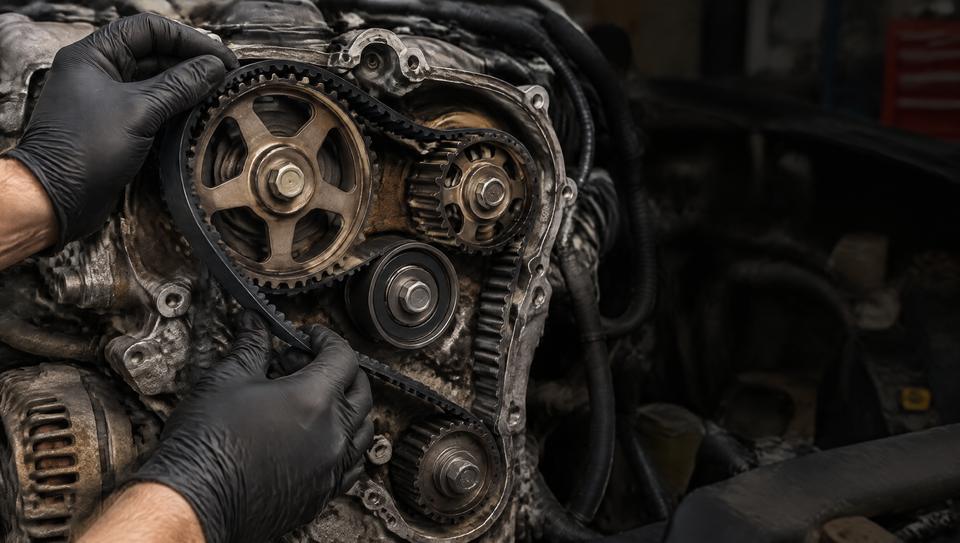
Engine cut out while driving and won't restart?
Get the car somewhere safe, away from the traffic, and put the hazard lights on. Don't keep cranking it: if the belt has gone, turning the engine over can add to the damage. Call roadside assistance if you have it. If anyone is hurt or in danger, call 000.
What does a timing belt do?
Two shafts have to stay in step inside an engine. The crankshaft turns with the pistons, and the camshaft opens the valves. The timing belt joins them with teeth, so every valve opens at the right moment for its piston.
Cambelt and timing belt are two names for the same part. It lives behind a cover, so you won't see it on a quick look under the bonnet. The ribbed belt you can see on the outside of the engine is a different part and a different job: that's under engine repairs.
When is a cambelt due?
Your maker's schedule decides, and there's no single number that's safe for every car. Look in the service book or owner's manual for the timing belt line. It's usually listed by kilometres and by age, so a car that does few kilometres can still be due.
Age counts because the rubber doesn't last forever. Heat and motor oil degrade it, and water or coolant can damage the cords inside, which is why a hot or leaky engine is hard on a belt. Worn belts give no real warning, so the engine can run perfectly right up to the day it stops.
Just bought a used car? If nothing in the book or the invoices shows the belt was done, treat it as not done until a mechanic has looked.
What happens if it snaps or strips its teeth?
The engine stops. How bad that is depends on the engine. In an interference engine, an open valve reaches into the space its piston travels through, so once timing is lost a piston can hit it and bend it.
If only the valves are bent, replacing them and the timing parts may be enough, though the cylinder head has to come off to do it. If the pistons and cylinders are damaged too, the engine likely needs a rebuild or replacement. Ask the mechanic which kind of engine you've got. It tells you how seriously to take the date in the book.
What about timing chains?
A chain is metal and has no routine replacement interval, which is why so many newer engines use one. It isn't a part you can forget about altogether. Poor lubrication, or a failed tensioner or guide, can finish a chain early, and a worn one typically rattles from the front of the engine. Regular oil changes are its maintenance. Timing belt vs timing chain has the full comparison.
What a good written estimate for a cambelt shows
- The belt, plus the tensioner and idler pulleys. A failed bearing in either can throw the belt off.
- The water pump, where the belt drives it. A seized pump can break a brand new belt, and it's easy to reach while everything's apart.
- Fresh coolant, if the cooling system has to be opened.
- Any oil or coolant leaks found behind the cover, because they'd shorten the new belt's life.
- Any drive belts or engine mounts that have to come off to get there.
- A note in the logbook, or a sticker under the bonnet, with the date and kilometres.
What makes the job bigger or smaller?
Access, mostly. The belt itself isn't the slow part: getting to it is. A sideways-mounted engine in a tight bay can mean supporting the engine and taking a mount off. A V-shaped engine has more pulleys and a longer belt to set. That's why two cars of a similar size can be very different jobs.
This is careful work. The mechanic lines up marks on the crank and cam, fits the belt, then turns the engine by hand to prove the timing before it's ever started. One tooth out matters, so it suits a mechanic who has done your kind of engine before.
What you can check, and what to leave
You can
- Find the timing belt line in your service schedule, if there is one.
- Look for a sticker under the bonnet or a logbook entry showing the last change.
- Ask a previous owner or seller for the invoice.
- Tell the mechanic about any oil or coolant leaks at the front of the engine.
Leave to the mechanic
- Taking the covers off and judging the belt's condition.
- Fitting the belt and setting the timing.
- The water pump and anything to do with the coolant. Never open a radiator or coolant cap on a hot engine.
Where we'd start
We'd find out three things first: belt or chain, when it was last done, and whether the engine is an interference design. If a belt is due, we wouldn't take it on one more long trip or tow. We'd have the belt, pulleys, tensioner and pump done together by a mechanic who knows that engine, then keep the invoice with the logbook for the next owner.