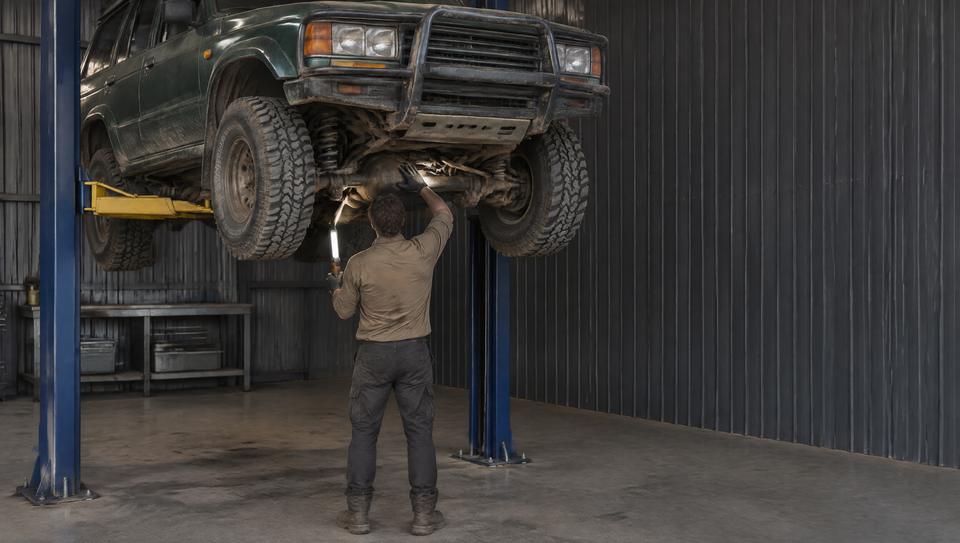
Why do 4WDs often get serviced sooner?
Because of how they're used here. Toyota keeps the HiLux, Prado and LandCruiser on six-month or 10,000 km service intervals, tighter than its hybrids and much of the industry. Toyota Australia told CarExpert those intervals are unique to Australia, because of Australian conditions, which can be quite harsh.
Every maker sets its own schedule, so check yours. Many books also list a heavier schedule for dusty roads, towing or regular water crossings. If that's your life, that's your schedule.
How you use it changes what to watch
| Mostly sealed roads | Towing or touring | Beach, mud and water | |
|---|---|---|---|
| Watch first | Tyres, brakes, the logbook schedule | Brakes, cooling, gearbox and diff oils | Corrosion, wheel bearings, diff and gearbox oil |
| Often missed | Using 4WD rarely, so it may need exercising | Suspension and tow bar wear under load | Water in the oils after a deep crossing |
| Ask the mechanic to check | That the 4WD system still engages | Bearings, bushes, cooling and tow gear | Breathers, seals, a clean underneath and fresh grease |
What's different about the drivetrain?
A 4WD has parts a normal car doesn't. The transfer case sends drive to the second axle, and often gives you a set of low-range gears. Each diff lets the wheels on that axle turn at different speeds, and some 4WDs add locking diffs that hold them together for traction. Each of these runs on its own oil, on its own schedule.
Part-time 4WD deserves a special mention. It has no centre diff, so the front and rear are locked together in the transfer case. That's fine on sand or gravel. On dry bitumen it causes driveline wind-up, because the axles can't turn at different speeds. If the steering feels tight or the car hops on a tight turn, take it out of 4WD and mention it to the mechanic.
After a big trip
Wash the underneath
Salt, mud and sand hold moisture against steel and rubber. Get it off soon after you're home, especially after the beach.
Check the air filter
On a dusty trip it can clog well before the next service. A filter that's blocked with dust starves the engine.
Mention any water crossings
Water can get into diffs, the transfer case and wheel bearings through breathers and seals. If you went deep, tell the mechanic and have the oils checked.
Listen on the way home
New clunks, whines or vibrations are easiest to describe while they're fresh. Note the speed, and whether it happens under power or coasting.
What about lift kits, bull bars and bigger tyres?
Modifications change how the car rides, brakes and wears out parts. A lift changes steering and driveshaft angles, and bigger tyres add load to the brakes and bearings. Rules on these differ by state and aren't covered here, so check with your state transport department and your insurer before you change anything. Tell the mechanic what's been fitted, because it affects what they look for.
What a good written estimate shows
- The service interval it's working to: normal, or the heavier schedule for your use.
- Which oils are being changed: engine, gearbox, transfer case, and front and rear diffs, by grade.
- Greasing of the driveshafts and any other points that need it.
- Filters: air, fuel and cabin, and on a diesel, what's due on the fuel system.
- Suspension, steering and brake findings, in plain words.
- Anything extra, shown separately, with what can wait until after the trip.
What you can do, and what's the mechanic's job
You can
- Check tyre pressures cold, and let them down only for the surface you're on.
- Check the oil and coolant before a long trip, on a cold engine.
- Run 4WD on a loose surface every so often, so the system gets used.
- Keep a note of crossings, towing and hard trips for the mechanic.
Leave to the mechanic
- Diff, gearbox and transfer case oils. These need the car level and safely supported.
- Brakes, wheel bearings and steering parts.
- Anything underneath the car. Never go under one held up only by a jack.
If it were our 4WD
We'd be honest about how the car is used and pick the schedule to match. Then we'd find a mechanic who works on 4WDs every week and ask them to go over it a few weeks before any big trip, which leaves time for parts to arrive. If you tow, say so, and ask about the brakes and cooling. It's a far better conversation at home than beside a track.