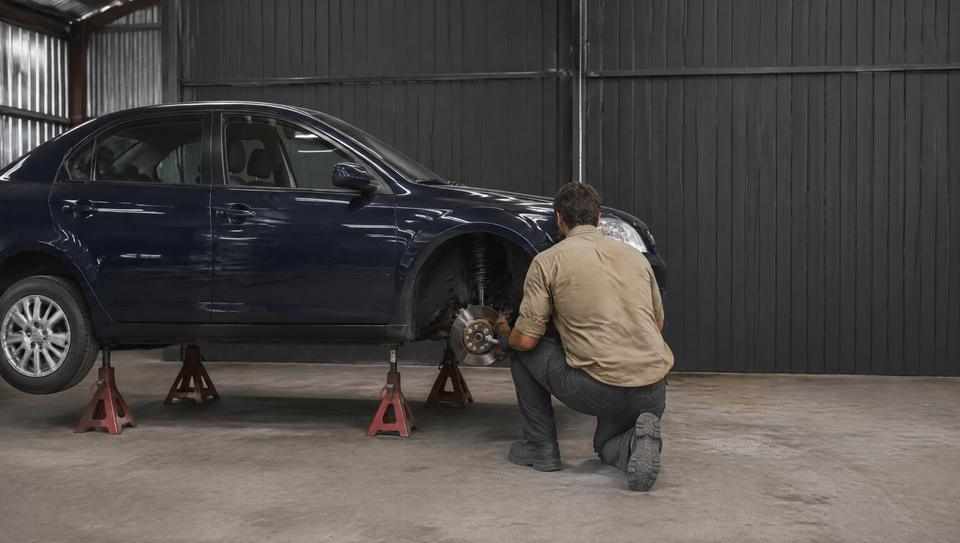
Steering gone heavy, or a bang from a front wheel? Stop first
If the steering suddenly goes heavy, a wheel feels loose, or you hear a loud bang or grinding from one corner, slow down, find somewhere safe to pull over and switch off. A CV joint that has let go can stop driving the wheel, and a worn steering part isn't something to test at speed. On a busy road, put your hazard lights on, get everyone out on the side away from the traffic if it's safe, and call roadside assistance if you have it. If anyone is hurt or in danger, call 000.
Why does a CV joint click on tight turns?
A front-wheel-drive car has a drive shaft running from the transmission to each front wheel, with a constant-velocity (CV) joint at both ends. The outer joint sits near the wheel and works at the sharpest angle whenever you steer, so the RAA says it wears out quicker than the inner one. A rear-wheel-drive ute has no drive shafts to its front wheels, so a clunk up front there points to the steering or suspension.
That's why the noise turns up in car parks, on U-turns and coming out of steep driveways. Tight turns are where these joints work hardest, and NRMA's used car advice is to put the steering on full lock, drive slowly and listen for a knock.
Each joint is packed with grease under a flexible rubber boot. Once that boot splits, grease escapes and water and grime get in. The RAA says a split boot needs urgent attention. Caught early, a new boot can save the joint. Left alone, the joint itself becomes the job.
What the noise on a turn usually means
| Most likely | How soon | |
|---|---|---|
| Rhythmic click or clunk on tight turns | An outer CV joint on a front-wheel-drive car or 4WD | This week, sooner if it's getting louder |
| A single clunk on a turn or over a bump | Steering or suspension joints, a wheel, or a worn wheel bearing | This week |
| Squeal as you turn the wheel, mostly parked or at low speed | A drive belt slipping while the power steering pump works harder | Soon. If that belt lets go, you lose more than the noise |
| Groan or whine on low-speed turns | Low or dirty power steering fluid, often from a fluid leak | This week, and look for drips under the car |
A quick test in an empty car park
Full lock, walking pace
Somewhere flat and empty, with the windows down and radio off, turn the wheel all the way one way and roll forward in a slow circle, then try the other way. A steady click that keeps time with the wheels points to a CV joint.
Stop and turn the wheel
With the car stopped and your foot on the brake, turn the wheel slowly from lock to lock. The wheels aren't being driven now, so a squeal or groan here isn't a CV joint. Think power steering or belt.
Look, don't crawl
Leave the wheels turned, put the handbrake on, and look behind the front wheel for a split rubber boot or grease flung around the inside of the rim. Don't get under the car.
What will the mechanic check?
The car goes up on a hoist so the mechanic can see both boots, feel for play in the drive shafts, and check the ball joints, tie rod ends and wheel bearings, which can all sound alike from the driver's seat. If it's more of a squeal, they'll look at the belt and the power steering fluid too.
This suits a mechanic who does steering and suspension work every week. NRMA points out that knocks while turning can also be loose suspension or body components, so ask what they found before anything gets replaced.
What to ask before you say yes
- Can you show me the split boot or the play in the joint?
- Is it only the boot so far, or has the joint worn too?
- Does the estimate replace the joint or the whole drive shaft, and why?
- Will the wheel alignment need checking afterwards?
What you can do, and what's the mechanic's job
You can
- Do the car park test and note which way the noise comes on.
- Look for a split boot or flung grease without going under the car.
- Check the power steering fluid, if your car has it, the way the owner's manual says.
- Keep a short phone video of the noise, with the sound on.
Leave to the mechanic
- Lifting the car and checking drive shafts, ball joints and tie rod ends.
- Any repair to steering parts, which have to be right before the car goes back on the road.
- Wheel alignment after steering or suspension work.
Our take
A click that only comes on tight turns, with the steering feeling normal: we'd send the job this week, go easy on U-turns and hard acceleration out of corners, and ask for both boots to be checked. A squeal that fades in a few seconds can wait a little, but not past your next service. Anything that changes how the steering feels, we'd park the car and ask for a mobile mechanic. Most of these turn out to be a straightforward find.