Smoke, a burning smell or a red oil light?
Pull over somewhere safe and switch off. Oil dripping onto a hot exhaust can smoke and, in rare cases, catch fire. A red oil light means pressure is low, so don't drive on with it lit. If there are flames, get everyone clear and call 000. Otherwise, call roadside assistance if you have it.
Where engine oil leaks start, from quick jobs to big ones
| Where it sits | How big the job tends to be | |
|---|---|---|
| Oil filter or sump plug | Under the engine | Usually quick, often a loose filter or tired washer |
| Valve cover gasket | On top of the engine, under the rocker cover | Often straightforward, but more work with a V engine or a crowded engine bay |
| Sump gasket | The pan at the bottom of the engine | Depends on what sits in the way, such as a crossmember or steering rack |
| Timing cover and front seals | Front of the engine, behind the belts | More work, and a good time to look at the timing belt |
| Rear main seal | Between the engine and the gearbox | Usually the biggest, because the gearbox has to come out |
What does a valve cover gasket do?
The valve cover, also called a rocker cover, bolts to the top of the engine and keeps oil around the valve gear. Its gasket seals that joint, and when it fails, oil can leak from the engine. Engines with more than one cylinder head have more than one cover, so a V6 can have two to deal with.
Gaskets get hard and shrink after years of heat. Oil then seeps out and runs down the side of the engine, often onto the exhaust, which is why a burning oil smell is a common first sign.
How does a mechanic find the leak?
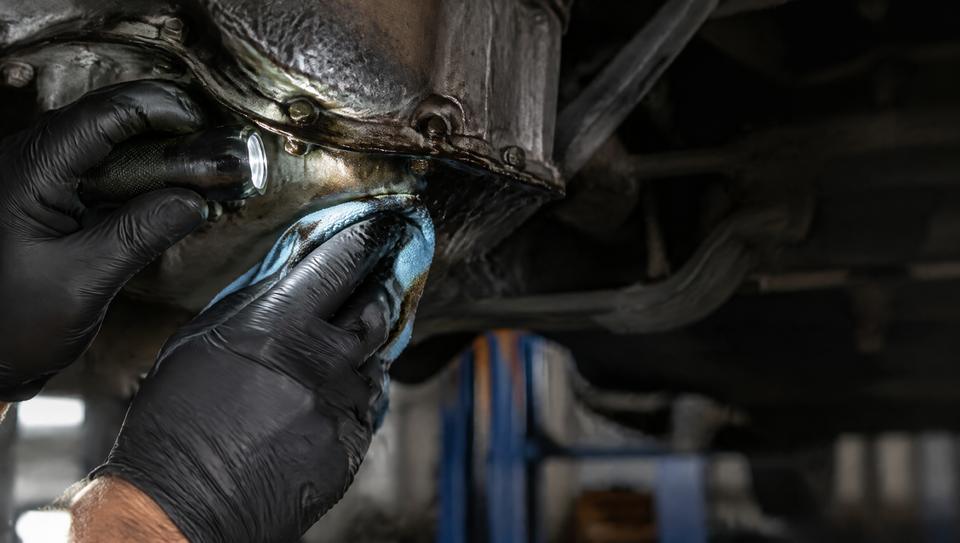
Oil travels. It runs downhill and gets blown backwards by the air under the car, so the wet patch is rarely right under the source. A leak that looks like a rear main seal can be a valve cover gasket running down the back of the engine.
A careful mechanic cleans the area first, then runs the car and looks again. A UV dye added to the oil can show the exact spot under a special light. Finding it properly is what stops you replacing the wrong seal.
Why do some leaks come back?
Often it's pressure, not the seal. Combustion gases slip past the piston rings into the bottom of the engine, and a ventilation system normally clears them. If that system blocks up, the pressure has nowhere to go. Excessive crankcase pressure can lead to oil leaks past the crankshaft seals and other seals and gaskets.
That's why it's worth asking about the PCV valve (the small valve that vents the engine) before a big seal job. A new seal on an engine with a blocked vent may not last long.
What a good written estimate shows
- Where the leak is, and how the mechanic confirmed it.
- The gasket or seal by name, plus any other parts that come off to reach it.
- Whether the engine ventilation system has been checked.
- For a rear main seal, what else comes out, and whether the clutch is worth doing at the same time on a manual.
- New oil and filter, if the oil has to be drained.
- Any other leaks found, listed apart, with how soon each needs doing.
What you can do, and what's the mechanic's job
You can
- Slide clean cardboard under the engine overnight to show where it's dripping and what colour it is.
- Keep the oil level in range, checked on a cold, level car.
- Take a photo of the patch, and note how quickly the level drops.
- Look for oil smoke from under the bonnet at traffic lights.
Leave to the mechanic
- Cleaning the engine and tracing the leak. Never go under a car held up only by a jack.
- Replacing gaskets and seals: bolts need to be tightened to the right setting.
- Anything near a hot exhaust.
What we'd do
We'd keep an eye on the level, get the leak traced properly, and only then decide. A slight weep may just need watching for a while, and a good mechanic will tell you that. A steady drip or a burning smell shouldn't wait. On a big job like a rear main seal, we'd ask how the source was confirmed and whether the ventilation system was checked first.