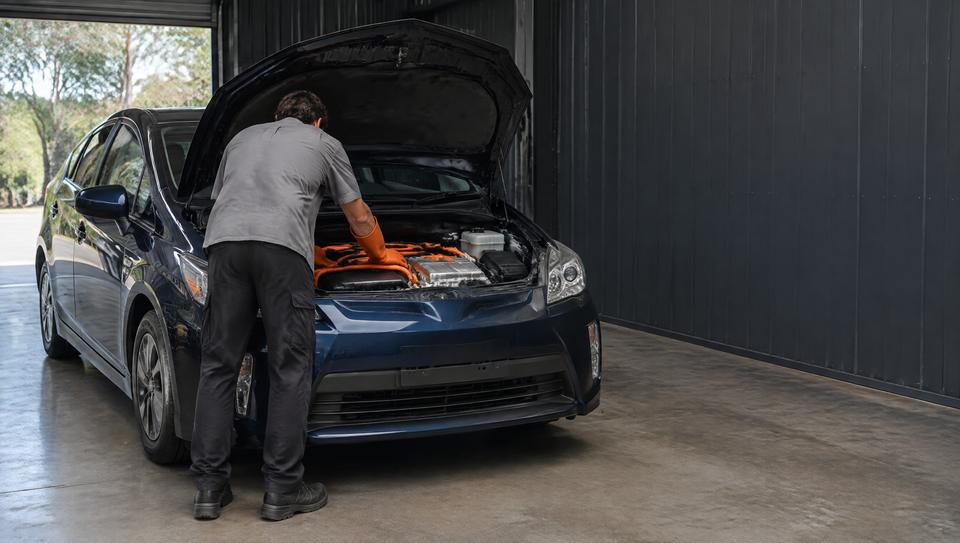
After a crash, or if the car smokes or smells of burning
Stop somewhere safe, switch off, and get everyone out and well away from the car. Don't touch the bright orange high-voltage cables or anything under the bonnet. If there's smoke, fire or anyone hurt, call 000 and tell them it's a hybrid or an electric car. A high-voltage warning on the dash also means stop, and get advice before driving any further.
What each kind of car still needs
| Hybrid | Plug-in hybrid | Full EV | |
|---|---|---|---|
| Engine oil and spark plugs | Yes | Yes, on the maker's schedule | No engine, so neither |
| Brakes, tyres, steering, suspension | Yes | Yes | Yes |
| 12-volt battery | Yes | Yes | Yes |
| Coolant for the battery and electrics | Depends on the car | Depends on the car | Often, on the maker's schedule |
| High-voltage battery checks | As the book lists | As the book lists | As the book lists |
What's the difference between the three?
A mild hybrid is essentially a normal car with some hybrid hardware, and it generally can't run on electricity alone. A full hybrid can run on the engine, the battery or both. A plug-in hybrid charges from a socket and can travel on the battery alone, and still has a petrol engine. Tell us which you've got, because the service schedule follows the car.
RAA makes the point that a hybrid's petrol engine needs servicing the same way as any other. Fewer engine hours doesn't mean no service: go by the book, by time as well as kilometres.
Who can work on a hybrid or EV?
Any good mechanic can do tyres, suspension or the oil on a hybrid, following the maker's procedure. Anything touching the high-voltage system is different. It has to be safely shut down first, and that takes training and the right gear.
Australia's national training register lists a Hybrid Electric Vehicle Inspection and Servicing Skill Set, which sits on top of a trade qualification. Its three units cover depowering and reinitialising hybrids, servicing their electrical components, and diagnosing and repairing their high-voltage batteries. RAA described its own trainers practising high-voltage isolation in gloves rated to 1,000 volts.
RAA also says high-voltage batteries are a category some repairers may have less experience in. So ask directly. It's a normal question, and a mechanic who has done the training will be glad to answer it.
Do EV brakes need less work?
Often, yes, but they still need looking at. With regenerative braking, the motor acts as a generator as you slow down, so pads and discs don't wear out as quickly. Friction brakes are still fitted, because regeneration alone can't safely stop a car. Brakes that get little use can seize or rust, so the check matters more than the kilometres suggest.
What happens if a hybrid battery starts to fail?
Start with the warranty. Battery cover often runs separately from the rest of the new car warranty, with its own terms, so check your book before anything else. Then it's about testing, not guessing. A warning light or falling fuel economy could be the battery, its cooling, a sensor or the 12-volt battery.
A proper test reads the battery's health and looks at how each section is holding up. From there, the options are usually a repair of the faulty part, a reconditioned battery or a new one. What decides it is the car's age, its warranty position and how the rest of the car is holding up. Ask for all the options in writing.
What a good written estimate shows
- The service by name, following the maker's schedule for that interval.
- Who is doing any high-voltage work, and that they're trained for it.
- Battery test results, if a battery is being repaired or replaced.
- Coolant by type, as the maker lists it.
- Anything else that's found, listed apart so you can say yes or no.
- That the logbook or digital record will be updated.
What you can do, and what to leave well alone
You can
- Check tyre pressures cold. EVs are heavy, so tyres work hard.
- Keep windscreen washer fluid topped up.
- Watch for new warning messages, and photograph them.
- Keep the car in regular use, because a hybrid's 12-volt battery can go flat if it sits.
Leave to the mechanic
- Anything with orange cables or orange covers. Never touch or open them.
- The high-voltage battery and its cooling.
- Brake work, which can need a special service mode on these cars.
Where we'd start
We'd sort the job into two piles. Tyres, brakes, suspension and a hybrid's oil service can go to a good local mechanic who knows your make. Anything with a high-voltage warning, a battery fault or orange cables goes to someone who can show you the training. Ask the question up front, keep the book in order, and you've got your choices covered.